


Between 3 April and 6 May 2026, the EU SME Centre, together with the European Union Chamber of Commerce in China, conducted a survey among European companies in the context of the preparatory work for the 2026/2027 Inter-Chamber SME Working Group Position Paper. The goal of this survey was to better understand what the key issues European companies operating in China (and in particular small and medium-sized enterprises (SMEs)) experience so that the Position Paper and other relevant publications would more accurately reflect their concerns and recommendations.
A total of 67 responses were received, among which 64 per cent are SMEs (and of these, 25 per cent are micro enterprises).[1]

Figure 1 Information Gathering Survey 2026/2027
In terms of industries and sectors, the five most represented are industrial manufacturing and components, professional services, machinery, chemicals and petroleum, and food and beverage.

Figure 2 Information Gathering Survey 2026/2027
85 per cent of respondents indicate they have been operating in China for more than 10 years, while 9 per cent have been in the country between one and five years, and the rest have been there between five and 10 years or less than one year.
In terms of location in China, 39 per cent of respondents are based in Shanghai, 19 per cent in Jiangsu, 16 per cent in Guangdong and another 15 per cent in Beijing. The rest are distributed among Tianjin, Shandong, Zhejiang, Sichuan and Fujian.
When looking at revenue sources, there is divergence between big and small players. 42 per cent of SME respondents indicate that more than 50 per cent of their revenue comes from European companies (B2B), while for 55 per cent of large respondents, the main source of revenue comes from Chinese companies (B2B). This can be attributed to European SMEs following their larger customers to China.

Figure 3 Information Gathering Survey 2026/2027 (SME respondents only)
Competition with Chinese private companies is the top challenge for both small and large respondents – this indicates the growing competitive pressure experienced by companies (both domestic and foreign) in the context of the slowing down of economic growth in China.
However, there are again divergences between large and small companies when looking at the second and third top challenges. For SMEs, the second biggest challenge is a tie between rising operational costs, IPR protection and late payments (40 per cent respectively). It is important to note, however, that late payments is listed as a “critical issue” (in the survey, a 5) by the highest percentage of SMEs. Meanwhile, larger companies report that intellectual property protection (54 per cent) and rising operational costs (50 per cent) are their second and third biggest challenges.

Figure 4 Information Gathering Survey 2026/2027 (SME respondents only)
When it comes to access to financing, limited access to government incentives and funding is the top issue for both large and small companies. In the case of SMEs, the second biggest challenge was difficulty obtaining loans (with 35 per cent indicating this is an issue), while for larger companies, it was a lack of collateral/their collateral not being accepted. 28 per cent of SME respondents indicated ‘none of the above’ as an answer, compared to 38 per cent of larger companies.

Figure 5 Information Gathering Survey 2026/2027 (SME respondents only)
Lack of transparency in regulatory requirements remained the top challenge for SMEs, while inconsistent enforcement was the key issue for large respondents. In the case of SMEs, this is followed by difficulties in obtaining licenses and permits and inconsistent interpretation of laws (30 per cent each), followed by inconsistent enforcement of regulations (28 per cent). For larger companies, high compliance costs (33 per cent), inconsistent interpretation of laws (also 33 per cent) and multiple and overlapping approvals (29 per cent) were also cited as key challenges, reflecting the more complex and widespread nature of their operations.

Figure 6 Information Gathering Survey 2026/2027 (SME respondents only)
Looking at late payments and unreasonable payment terms, large and small respondents both report having experienced these issues, mostly from private companies (58 per cent as opposed to 45 per cent in 2025), with 19 per cent indicating they have faced challenges with late payments or unreasonable payment terms from state-owned enterprises (SOEs) and 12 per cent from local governments. 34 per cent have not faced these challenges, as opposed to 39 per cent in 2025.

Figure 7 Information Gathering Survey 2026/2027
When it comes to perceptions of both the state of China’s IPR legislation and enforcement, more than half of the large respondents indicate that IPR legislation and IPR enforcement are adequate (62 and 61 per cent respectively), with 29 per cent and 30 per cent respectively indicating they are very poor or poor. Meanwhile, less than half (47 and 49 per cent respectively) of small respondents indicate that IPR legislation and enforcement are adequate. 28 per cent of SME respondents indicate that IPR legislation in China is very good or excellent (with 26 per cent indicating it is very poor or poor), while 35 per cent indicate that IPR enforcement is very poor or poor.

Figure 8 Information Gathering Survey 2026/2027 (SME respondents only)

Figure 9 Information Gathering Survey 2026/2027 (SME respondents only)
The top issues for SME respondents linked to IPR protection are ineffective enforcement of laws (30 per cent), followed by a tie between piracy and counterfeiting and high costs of IPR protection (21 per cent respectively). 28 per cent indicate they experience none of the above issues. Meanwhile, 50 per cent of large respondents indicate they experience issues with piracy and counterfeiting, with 42 per cent citing high costs of enforcement and 33 per cent, ineffective enforcement. 20 per cent indicate they experience none of the above issues.

Figure 10 Information Gathering Survey 2026/2027 (SME respondents only)
The Inter-Chamber SME Working Group Position Paper will be published in September 2026.
Our Advocacy Platform collects information and facts about the challenges and problems faced by EU SMEs in China through the Inter-Chamber SME Working Group. It also tracks SME policy developments. The results of this research are then consolidated into two major publications: the annual Inter-Chamber SME Working Group Position Paper and the SME Policy Environment Report.

The 2025/2026 Inter-Chamber SME Working Group Position Paper outlined policy and regulatory developments affecting European SMEs in China throughout the past year. Its key recommendations aimed to address issues encountered by small and medium-sized enterprises, including in access to financing, timely payments, and IPR protection. Read the 2025/2026 SME Position Paper here >
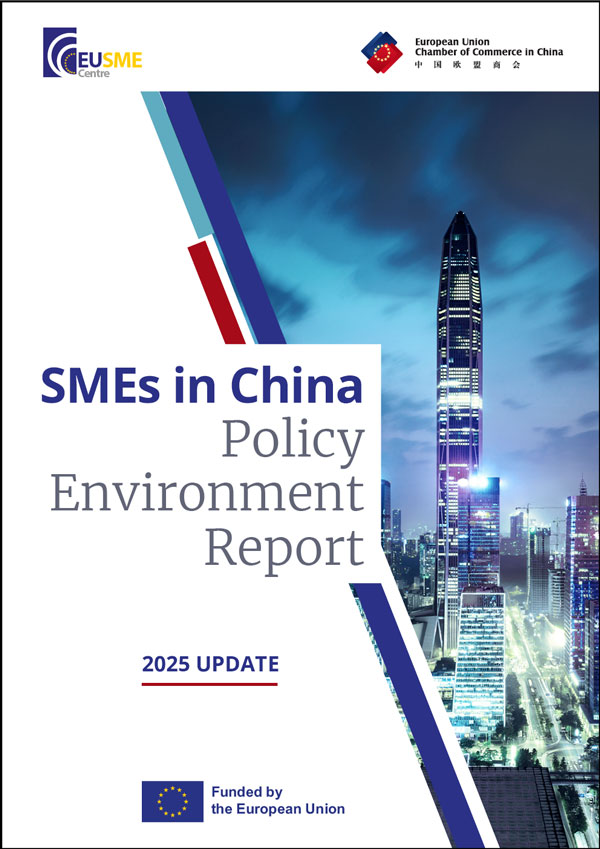
The SME Policy Environment report sets out to provide an overview of the most significant developments affecting SMEs operating in the country throughout the past year. The structure of the report consists of an introduction to SMEs in China, an analysis of the current policy environment of SMEs in various areas and a conclusion. The SME Policy Environment Report is updated on an annual basis. Read the 2025 SME Policy Environment Report here >
[1] For the purpose of this survey, the criteria used to define SMEs is headcount (1-250 employees worldwide).